Examples of Churches and Religious Movements Often Described as Cults
How Experts Define Cults
The word “cult” is highly controversial, and many academics prefer expressions such as high-control group, destructive religious movement, or new religious movement. However, organisations such as the International Cultic Studies Association (ICSA), the Cult Education Institute, and experts including Steven Hassan and Rick Alan Ross use the term to describe groups that demonstrate patterns of psychological manipulation, excessive control, and undue influence over members.
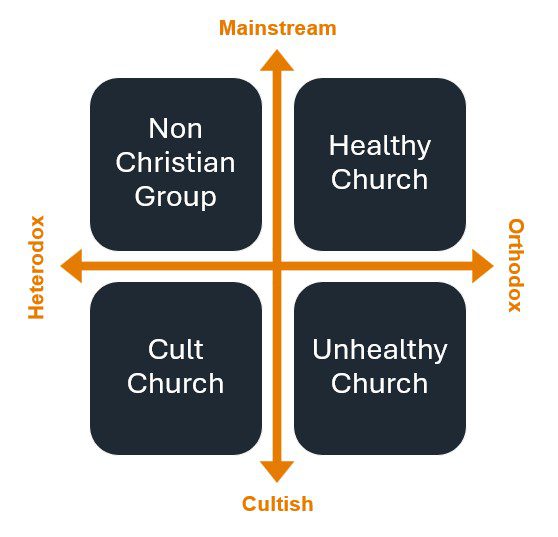
Organisations that fit the bottom-right quadrant of the diagram above are broadly orthodox, but also cult-like due to coercive control, a lack of accountability, and a charismatic leader. These are included in our cult church list, along with the more obvious heterodox cult churches.
The following are among the best-known religious organisations that have frequently been described by researchers, former members, journalists, and cult experts as displaying cult-like characteristics:
Table of Contents
The Unification Church (The Moonies)
Founded in South Korea in 1954 by Sun Myung Moon, the Unification Church became internationally famous for its mass wedding ceremonies and its belief that Moon was the Messiah sent to complete Jesus’ unfinished mission. Former members and researchers have criticised the movement for intensive recruitment methods, strict control over members’ lives, and financial demands. Globally respected cult expert Steve Hassan escaped from this group, giving it additional high-profile exposure.
- Official website: https://familyfed.org/
- Further information: https://en.wikipedia.org/wiki/Unification_Church
The Family International (formerly Children of God)
Founded by David Berg during the late 1960s, The Family International became notorious for authoritarian leadership, communal living, and numerous abuse scandals. During its early years, it promoted highly controversial practices including “Flirty Fishing”, where members used sexual relationships as a recruitment method.
- Official website: https://www.thefamilyinternational.org/
- Further information: https://en.wikipedia.org/wiki/The_Family_International
Church of Scientology
Founded by science-fiction writer L. Ron Hubbard in the 1950s, Scientology teaches that spiritual advancement can be achieved through expensive courses and auditing sessions. Critics, former members and many cult experts argue that the organisation exercises excessive control over followers through financial pressure, confidentiality agreements, internal discipline and social isolation. Although Scientology was not originally established as a church, it has obtained religious recognition in several countries, including the United States and the United Kingdom. Its imposing buildings in prominent locations, bristling with security cameras and security guards, help make this cult particularly well known for its size.
- Official website: https://www.scientology.org/
- Further information: https://en.wikipedia.org/wiki/Scientology
Twelve Tribes
The Twelve Tribes is a communal Christian movement founded in the United States during the 1970s. Members typically live together in tightly controlled communities, educate children within the group, and maintain strict gender roles. Former members have alleged excessive control, harsh discipline and isolation from wider society.
- Official website: https://twelvetribes.org/
- Further information: https://en.wikipedia.org/wiki/Twelve_Tribes_communities
Fundamentalist Church of Jesus Christ of Latter-Day Saints (FLDS)
The FLDS Church is a fundamentalist Mormon movement that separated from the mainstream Church of Jesus Christ of Latter-day Saints. It became internationally known under the leadership of Warren Jeffs, who was convicted of child sexual assault. The group is associated with polygamy, arranged marriages, authoritarian leadership and severe restrictions on members.
- Further information: https://en.wikipedia.org/wiki/Fundamentalist_Church_of_Jesus_Christ_of_Latter-Day_Saints
Shincheonji Church of Jesus
Founded in South Korea by Lee Man-hee, Shincheonji teaches that its founder is the promised pastor spoken of in the Book of Revelation. The organisation has attracted worldwide attention for allegedly concealing members’ identities during recruitment and encouraging secrecy until recruits become fully committed.
- Official website: https://www.shincheonji.kr/
- Further information: https://en.wikipedia.org/wiki/Shincheonji_Church_of_Jesus
Church of Almighty God (Eastern Lightning)
Originating in China during the early 1990s, the Church of Almighty God teaches that Jesus has returned as a Chinese woman. The movement is highly controversial and has been accused of coercive recruitment and authoritarian leadership. It has also faced severe persecution by the Chinese government, making objective information particularly important when researching the group.
- Official website: https://www.hidden-advent.org/
- Further information: https://en.wikipedia.org/wiki/Church_of_Almighty_God
Universal Church of the Kingdom of God (UCKG)
Founded in Brazil in 1977, the UCKG is a large Pentecostal movement with churches around the world, including the United Kingdom. Critics have accused the church of placing excessive emphasis on financial giving and prosperity theology, while former members have described experiences of manipulation and spiritual pressure.
- Official website: https://www.uckg.org/
- Further information: https://en.wikipedia.org/wiki/Universal_Church_of_the_Kingdom_of_God
Word of Faith Fellowship
Based in North Carolina, USA, Word of Faith Fellowship has been criticised by former members, journalists and investigators for alleged emotional abuse, physical punishment, forced confessions and controlling leadership. The church has been the subject of numerous investigations and documentaries.
- Official website: https://www.wordfaith.org/
- Further information: https://en.wikipedia.org/wiki/Word_of_Faith_Fellowship
Tony Alamo Christian Ministries
Founded by Tony Alamo, this ministry attracted widespread attention after Alamo was convicted of child sex offences. Former members have described an authoritarian environment involving isolation, fear and complete obedience to leadership.
- Further information: https://en.wikipedia.org/wiki/Tony_Alamo_Christian_Ministries
The Jesus Fellowship Church (Jesus Army)
Once one of Britain’s largest communal evangelical churches, the Jesus Fellowship Church encouraged members to live in shared households under strong pastoral oversight. Following numerous allegations of physical and sexual abuse, together with findings of coercive control, the church dissolved in 2019.
- Further information: https://en.wikipedia.org/wiki/Jesus_Army
Plymouth Brethren Christian Church (PBCC)
The Plymouth Brethren Christian Church (formerly Exclusive Brethren) is a separatist Christian denomination that originated from within the wider Plymouth Brethren movement. Former members and several researchers have criticised the group for strict social separation, shunning of former members, limitations on outside relationships and a highly centralised leadership structure. The church rejects these criticisms and states that its practices are based on Biblical principles.
- Official website: https://www.plymouthbrethrenchristianchurch.org/
- Further information: https://en.wikipedia.org/wiki/Plymouth_Brethren_Christian_Church
Historical Examples of Destructive Religious Groups
The following groups are no longer representative of active churches but remain among the best-known examples of destructive religious movements.
Peoples Temple
Founded by Jim Jones, Peoples Temple ended in one of history’s worst cult tragedies when more than 900 followers died at Jonestown in Guyana in 1978 after Jones ordered a mass murder-suicide. The event remains one of the clearest examples of absolute authoritarian control within a religious movement.
- Further reading: https://en.wikipedia.org/wiki/Peoples_Temple
Branch Davidians
The Branch Davidians became internationally known following the 1993 siege at Waco, Texas. Led by David Koresh, the group believed Koresh had a unique prophetic role and exercised extensive control over members’ lives. The siege resulted in the deaths of more than 70 members.
- Further reading: https://en.wikipedia.org/wiki/Branch_Davidians
Learn More About High-Control Religious Groups
If you would like to understand how experts identify unhealthy religious groups, these organisations provide reliable, research-based information.
- International Cultic Studies Association Resource Library: https://library.internationalculticstudies.org/
- Cult Education Institute Cult List Archive (very comprehensive): https://culteducation.com/group.html
- Steven Hassan’s Freedom of Mind Resource Centre: https://freedomofmind.com/
- Cult Information Centre (UK): Their website is currently hacked; we will add the link here as soon as it is safe to do so.
These organisations provide educational material on undue influence, coercive control, psychological manipulation, and recovery from high-control groups.
Comprehensive Cult Church List
Aided by information from the Cult Education Institute website (which has assembled one of the largest archives of information about controversial groups, cults, and related information on the Web), we have come up with the following categorised list of cult churches:
Tier 1: High-Control & Dangerous Groups
These are widely recognised (academically, legally, or historically) as coercive, abusive, or violent.
Violent / Terror-Linked / Extremist
- Al-Qaeda
- ISIS / Islamic State
- Boko Haram
- Ku Klux Klan
- Aryan Brotherhood
- Aryan Nations
- Lord’s Resistance Army
- Mungiki
- People’s Mujahedeen
- Symbionese Liberation Army
- Heaven’s Gate
- Solar Temple
- Aum Sect (Aum Shinrikyo)
- Movement for the Restoration of the Ten Commandments of God
- Jonestown / Peoples Temple
High-Control Religious / Psychological Abuse (widely documented)
- NXIVM
- Scientology
- Children of God / The Family
- Twelve Tribes
- Twin Flames Universe
- Love Has Won
- Church of Almighty God
- Shinchonji Church
- International Church of Christ
- The Family (Australia – Anne Hamilton-Byrne group)
- Synanon
- Rajneesh Movement (Osho)
- Unification Church
Isolated / Closed Communities with Abuse Allegations
- Gloriavale
- Lev Tahor
- Colonia Dignidad
- House of Yahweh
- Word of Faith Fellowship
- Westboro Baptist Church
- Jesus Army
Tier 2: High-Control (Non-violent but coercive traits)
These groups are frequently flagged in academic literature for strong psychological control, though not necessarily violent.
- Landmark Education
- Lifespring
- Sahaja Yoga
- Soka Gakkai
- Kabbalah Centre
- Opus Dei
- International House of Prayer
- Jehovah’s Witnesses
- Mormon Church
- Iglesia ni Cristo
- Universal Church of the Kingdom of God
- Shincheonji (overlaps Tier 1 depending on source)
Tier 3: Contested / Mixed Classification
These are sometimes labelled cults, but not consistently supported by academic consensus.
- Amish
- Exclusive Brethren (now Plymouth Brethren Christian Church or PBCC)
- Hutterites
- ISKCON (Hare Krishna movement)
- Transcendental Meditation
- Falun Gong
- Hillsong Church
- Chabad Lubavitch
- Art of Living Foundation
These may be better described as:
- New religious movements
- High-demand religions
- Or simply controversial organizations
This list of cult churches is far from comprehensive (there are 1000s!), but it does provide an overview of the large, controversial, or well-known cults.
Some of these groups, especially those in tier 3, may contain many peaceful and loving Christians, who happen to be in a group who’s leadership has been infiltrated by the “grievous wolves” that the apostle Paul warns about in Acts 20:29 KJV, so it is important to approach the individual members of these groups respectfully and with an open mind, and not tar them all with the same brush.