
Is Communism A Cult?
At a glance:
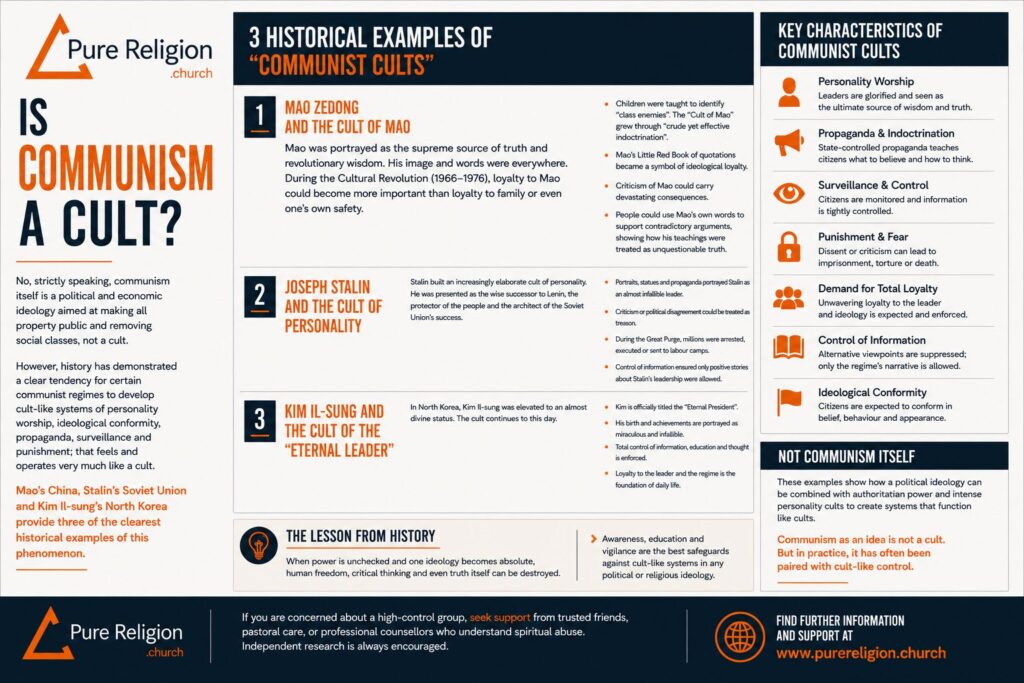
Strictly speaking, communism itself is a political and economic ideology aimed at making all property public and removing social classes, not a cult. However, history has demonstrated a clear tendency for certain communist regimes to develop cult-like systems of personality worship, ideological conformity, propaganda, surveillance and punishment; that feels and operates very much like a cult.
Mao’s China, Stalin’s Soviet Union and Kim Il-sung’s North Korea provide three of the clearest historical examples of this phenomenon.
3 Historical Examples of “Communist Cults”
Mao Zedong and the Cult of Mao
Perhaps the clearest historical example of a communist leader developing a cult of personality is Mao Zedong, who led the People’s Republic of China from its establishment in 1949 until his death in 1976.
During the height of his power, Mao was elevated far above simply being the leader of the communist party; he was portrayed as the supreme source of political truth and revolutionary wisdom. His portrait was displayed throughout the country, his writings were treated as authoritative, and millions of people were encouraged to study and memorise his words. During the Cultural Revolution, which began in 1966, loyalty to Mao could become more important than loyalty to family, traditional morality or even one’s own safety.
Jung Chang’s book “Wild Swans: Three Daughters of China” provides a particularly striking first-hand account of this phenomenon. Chang describes growing up in a society in which Mao had acquired an almost sacred status. One slogan taught to Chinese citizens captured the extent of this devotion:
“Father is close, Mother is close, but neither is as close as Chairman Mao.”
Chang also describes how the cult of Mao was deliberately cultivated through education and propaganda. She writes that the “Cult of Mao” began through what she calls “crude yet effective indoctrination”, as children were taught to identify supposed “class enemies” and to regard Mao as the nation’s great protector.
The Cultural Revolution intensified this dramatically. Young people were encouraged to become Red Guards and to demonstrate their revolutionary commitment publicly. Mao’s Little Red Book, a collection of his quotations, became an almost ubiquitous symbol of ideological loyalty. Criticism of Mao could carry devastating consequences.
Chang herself became a Red Guard as a teenager. In Wild Swans, she describes travelling to Beijing in the hope of seeing Mao. When she finally saw his motorcade, she caught only a brief glimpse of him. The experience nevertheless illustrates the extraordinary emotional significance attached to the leader. Chang describes the surrounding Red Guards celebrating ecstatically and one girl pricking her finger to write a message expressing her happiness at seeing “our Great Leader Chairman Mao”.
The system also demonstrated another characteristic associated with cult-like environments: the erosion of independent sources of truth. Mao’s teachings were repeatedly used to determine what was politically acceptable, while alternative information was suppressed. Chang later recalled that people could use Mao’s own quotations to support contradictory arguments, illustrating how the leader’s words had become an unquestionable ideological authority.
Mao’s China demonstrates how a political ideology can be combined with authoritarian power and an intense personality cult to create a society in which conformity, devotion to a leader and ideological control become extraordinarily powerful.
Joseph Stalin and the Cult of Personality
Joseph Stalin provides another important example. As leader of the Soviet Union from the late 1920s until his death in 1953, Stalin transformed the Communist Party into a highly centralised political system in which loyalty to him became increasingly important.
The Soviet Union already possessed a powerful ideological framework based on Marxism-Leninism. Under Stalin, however, this was accompanied by an increasingly elaborate cult of personality. Stalin was presented as the wise successor to Lenin, the protector of the Soviet people and the architect of the country’s transformation into a major industrial power.
His image appeared throughout Soviet society. Portraits and statues of Stalin were commonplace, his speeches and writings were treated with enormous authority, and official propaganda presented him as an almost infallible political genius. His birthday and public appearances became occasions for carefully orchestrated demonstrations of loyalty.
Political disagreement could be interpreted as evidence of disloyalty to the revolution itself. During the Great Purge of the 1930s, millions of people were arrested, imprisoned, executed or sent to labour camps. Senior Communist Party officials, military officers, intellectuals and ordinary citizens could be accused of being “enemies of the people”.
This created an environment in which people had powerful incentives to conform publicly, regardless of what they privately believed.
The Soviet system also demonstrates the importance of controlling information. Propaganda portrayed Stalin’s leadership in overwhelmingly positive terms, while photographs, historical accounts and official records could be altered to remove people who had fallen from favour. Former allies could effectively disappear from the approved historical narrative.
There were therefore several features that can reasonably be described as cult-like: extreme leader worship, ideological absolutism, public demonstrations of loyalty, suppression of dissent and the punishment of people identified as ideological enemies.
Stalin’s Soviet Union was an unhealthy blend of personality cult and totalitarian political state. Its system of control depended on the Communist Party, government institutions, censorship, the security services, the courts, prisons and the labour-camp system as well as propaganda and ideological indoctrination.
The Stalin example demonstrates what can happen when an ideological movement becomes concentrated around an authoritarian leader and dissent is treated as a threat to the entire political order.
Kim Il-sung and the Creation of North Korea’s Personality Cult
Kim Il-sung provides perhaps the most enduring example of a communist personality cult.
After establishing himself as the leader of North Korea following the Second World War, Kim gradually developed a political system centred not simply on the Communist Party, but on his own leadership and the ideology of Juche. His authority was subsequently passed through his family, with his son Kim Jong-il and grandson Kim Jong-un continuing the dynastic leadership of the country today.
The personality cult surrounding Kim Il-sung became deeply embedded in everyday life. His image was displayed throughout North Korea, citizens were expected to demonstrate loyalty to the leadership, and official propaganda portrayed him as the heroic founder and protector of the nation.
North Korean propaganda constructed an almost mythological account of Kim Il-sung’s life and achievements, elevating his status far above that of a successful political leader. His revolutionary credentials were celebrated from childhood onwards, while the state’s educational and propaganda systems reinforced the idea that the country’s survival and prosperity depended upon loyalty to the Kim leadership.
The result was a political system in which personal loyalty and ideological loyalty became extremely difficult to separate.
The North Korean system also illustrates another feature often associated with cult-like groups: information control. North Koreans have historically faced severe restrictions on access to outside information. Independent media and political opposition are effectively absent, while the state exercises extensive control over education, broadcasting and public expression.
This matters because control over information can make a leader’s claims extraordinarily difficult to challenge. If citizens are repeatedly told that their leader is uniquely wise, heroic and indispensable, while alternative accounts of reality are inaccessible or dangerous to discuss, the normal mechanisms by which people test political claims are severely weakened.
The Kim dynasty therefore represents an extreme example of the fusion of communist political structures, nationalist ideology, hereditary leadership and personality cult.
North Korea’s system has evolved considerably beyond classical Marxist ideas. Its distinctive characteristics include extreme authoritarianism, hereditary rule, nationalism, military priorities and the institutionalised worship of the ruling Kim family.
For this reason, North Korea is perhaps better described as a totalitarian dynastic state with communist origins and an exceptionally developed personality cult than simply as “a communist cult”.
What These Three Examples Have in Common
Mao’s China, Stalin’s Soviet Union and Kim Il-sung’s North Korea were very different societies, and it would be historically inaccurate to suggest that they were identical. Nevertheless, all three demonstrate how a political ideology can acquire cult-like characteristics when combined with concentrated authoritarian power.
Several recurring patterns can be seen:
- Leader worship: The political leader becomes more than an ordinary politician and is portrayed as uniquely wise, heroic or indispensable.
- Ideological absolutism: Official doctrine is treated as unquestionably correct, while disagreement is portrayed as dangerous or morally corrupt.
- Information control: Propaganda and censorship restrict access to competing explanations of reality.
- Punishment of dissent: People who challenge the leadership or ideology may face social exclusion, imprisonment or much more severe consequences.
- Pressure to conform: Citizens are encouraged to demonstrate loyalty publicly, even when their private beliefs may be different.
- Invasion of personal life: Political loyalty can extend into education, employment, family relationships and everyday behaviour.
These characteristics overlap with features commonly associated with cultic or high-control groups.
Communism itself is a broad family of political and economic ideas concerning ownership, class and the organisation of society. There have also been communist movements and parties that differed enormously in their structures, goals, and relationships with political power.
A key takeaway is that an ideology does not need to be religious to serve as the basis of a high-control system. When political power becomes concentrated, criticism is suppressed, alternative sources of information disappear and loyalty to a leader becomes a measure of personal virtue, a movement can begin to display many of the psychological and social characteristics associated with cults.
How Communism Differs From a Cult
- Definition: It is a large-scale theory about government, wealth, and labour.
- Scope: Millions of people follow different types of communist ideas, ranging from democratic socialism to revolutionary Marxism.
- Goals: Its stated aim is a classless society without a state, rather than devotion to a single spiritual leader.
Why Some Compare Communism to a Cult
- Charismatic leaders: Many historic communist leaders – like Joseph Stalin, Mao Zedong, and Kim Il-sung – built massive personal devotion, demanding total praise and worship from the public.
- Strict Dogma: Parties often treat core texts as absolute truth and punish any disagreement or different opinion as dangerous “heresy”.
- Total Control: Authoritarian communist states used intense propaganda, information control, secret police, and severe social rules to control how people lived, thought, and worked.
In short, while communism is an economic theory, authoritarian regimes that used it often adopted cult-like practices to stay in power.