
3D Analysis of Cult Churches by Top Experts
Over the past 70 years, some of the world’s leading psychologists, psychiatrists and sociologists have studied how cults and other high-control groups influence people’s thinking and behaviour.
Although each expert approached the subject from a different angle, they reached remarkably similar conclusions.
Their research consistently highlights techniques such as information control, isolation, manipulation, dependency, identity change and psychological persuasion.
This article summarises the key insights from four of the most influential cult specialists, providing a concise, research-based overview of the warning signs and methods commonly associated with coercive control.
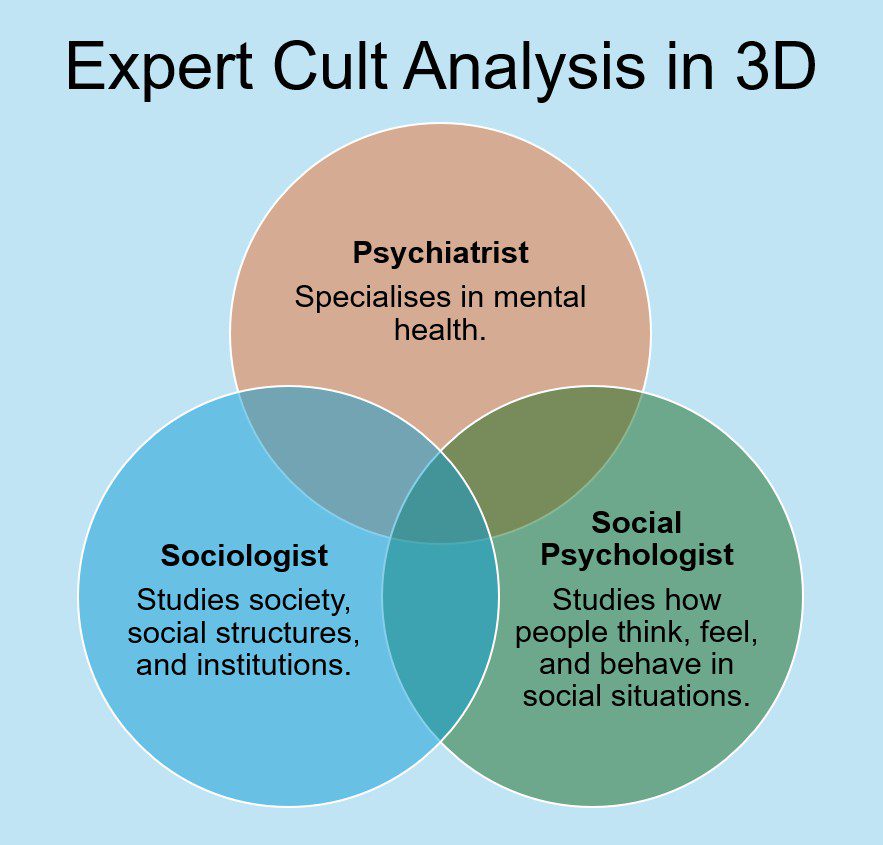
Insights from 4 world-class cult specialists:
1) Robert J. Lifton
Bio: Dr Robert Jay Lifton is an American psychiatrist and distinguished professor who specialised in the psychology of totalism. He is world-renowned for his groundbreaking 1961 study on cognitive remoulding and psychological vulnerability, which provided the foundational criteria for analysing thought reform.
Core Theories and Insights:
Milieu Control: The strict limitation of all communication and information reaching an individual from the outside world, creating a closed information ecosystem.
Mystical Manipulation: Orchestrating events or experiences that appear supernatural or divinely ordained to make the group’s leadership seem selected by a higher power.
Demand for Purity: Dividing the universe into an absolute black-and-white binary of pure good (the group) and absolute evil (the outside world).
Cult of Confession: Requiring members to confess sins, doubts, and past mistakes to leadership, which is later weaponised to destroy individual boundaries.
Sacred Science: Elevating the group’s primary dogma to an absolute truth that cannot be questioned by logic, science, or human reason.
Loading the Language: Compressing complex human thought into thought-terminating clichés and jargon that restrict critical thinking.
Doctrine Over Person: Prioritising the group’s abstract teachings over actual human experiences, rewriting individual histories to fit the narrative.
Dispensing of Existence: Proclaiming that only those inside the group have a right to exist, be happy, or achieve spiritual salvation.
2) Margaret T. Singer
Bio: Dr Margaret Singer was a clinical psychologist and professor at UC Berkeley who specialised in the treatment of former cult members. She spent decades researching the mechanics of coercive persuasion and the systematic steps groups use to destabilise an individual’s identity. She wrote the well-known book ‘Cults In Our Midst’, as pictured here.

Core Theories and Insights:
Behavioural Destabilisation: Systematically altering an individual’s physical environment, sleep patterns, and daily routines to break down their emotional resilience.
Unconditional Reality Redefinition: Forcing a newcomer to accept a new worldview by punishing critical thinking and rewarding compliance.
Exploitation of Vulnerabilities: Utilising a person’s underlying anxieties, past traumas, or psychological transitions (like moving or a breakup) to gain leverage.
Controlled Dependency: Forcing members to rely completely on the group for emotional support, financial decisions, and validation, isolating them from their biological families.
Enforced Suppression of Critical Thought: Training members to suppress negative thoughts, doubts, or criticisms of the leader through psychological defence mechanisms.
Systematic Isolation: Physically or socially detaching individuals from any external sounding boards or objective third parties who could break the psychological loop.
3) Richard J. Ofshe
Bio: Dr Richard Ofshe is an American sociologist and professor emeritus at UC Berkeley specialising in coercive social control. He is a leading expert on thought reform programmes, organisational transformation, and how social systems produce false confessions or fabricated memories. His most famous cult-related work was exposing the Synanon cult; he is the co-author of ‘The Light On Synanon’ along with Dave Mitchell and Cathy Mitchell, as pictured here.

Core Theories and Insights:
Programmatic Thought Reform: Emphasising that cult control is not a sudden “brainwashing” but a step-by-step, organised social system managed within a structured environment.
Identity Manipulation: Forcing members to publicly denounce their previous lifestyle, values, and identities as unworthy or corrupted.
Manufactured Emotional Vulnerability: Using peer pressure and structured social interactions to trigger severe, genuine guilt regarding past behaviours.
Coercive Dependency: Constructing a reward system where an individual can only find relief from manufactured guilt by complying with organisational demands.
Totalitarian Organisational Evolution: Analysing how groups like Synanon transition from benign self-help communities into abusive, self-serving corporations focused entirely on protecting leadership power.
4) Robert B. Cialdini
Bio: Dr Robert Cialdini is a professor emeritus of psychology and marketing at Arizona State University. He is the world’s leading authority on the principles of persuasion, compliance, and how social shortcuts can be weaponised to manipulate human behaviour. He is the author of the best-selling book “Influence: The Psychology of Persuasion”.

Core Theories and Insights:
Reciprocity: Forcing a feeling of debt by offering unexpected gifts, favours, or intense initial affection (commonly known as “love bombing”).
Commitment and Consistency: Leveraging a person’s desire to act aligned with prior statements by securing tiny initial agreements that escalate into extreme sacrifices.
Social Proof: Exploiting the human instinct to look to peers for correct behaviour, surrounding targets with a wall of uniform, ecstatic validation.
Liking: Relying on highly charming, relatable, or physically attractive recruiters who mimic the target’s interests to bypass natural scepticism.
Authority: Demanding automatic compliance through the display of absolute titles, perceived wisdom, or symbols of power.
Scarcity: Manufacturing an artificial sense of urgency by claiming that salvation, truth, or membership is highly exclusive and limited.
Unity: Exploiting the deep, evolutionary need for belonging by establishing a shared tribal identity that frames all outsiders as a