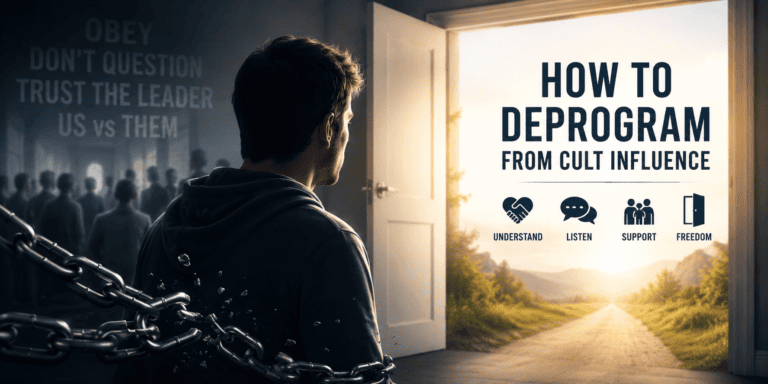

Cult Warning Signs
Expert analysis on top cult warning signs
According to experts such as Robert Lifton, Margaret Singer, Richard Ofshe, and Robert Cialdini, the most reliable sign that a group is a cult is the presence of unethically high levels of control across psychological, environmental, informational, social, and identity control. Other pervasive signs of a cult, according to the experts, are:
- A charismatic leader or small group of leaders who have no accountability and are regarded as perfect or divinely guided
- A them and us mentality – people inside are good and are saved, people outside are bad and are lost
- Fear, often enforced through behaviour-based consequences and a strong culture of personal disclosure (confession) to the group leaders
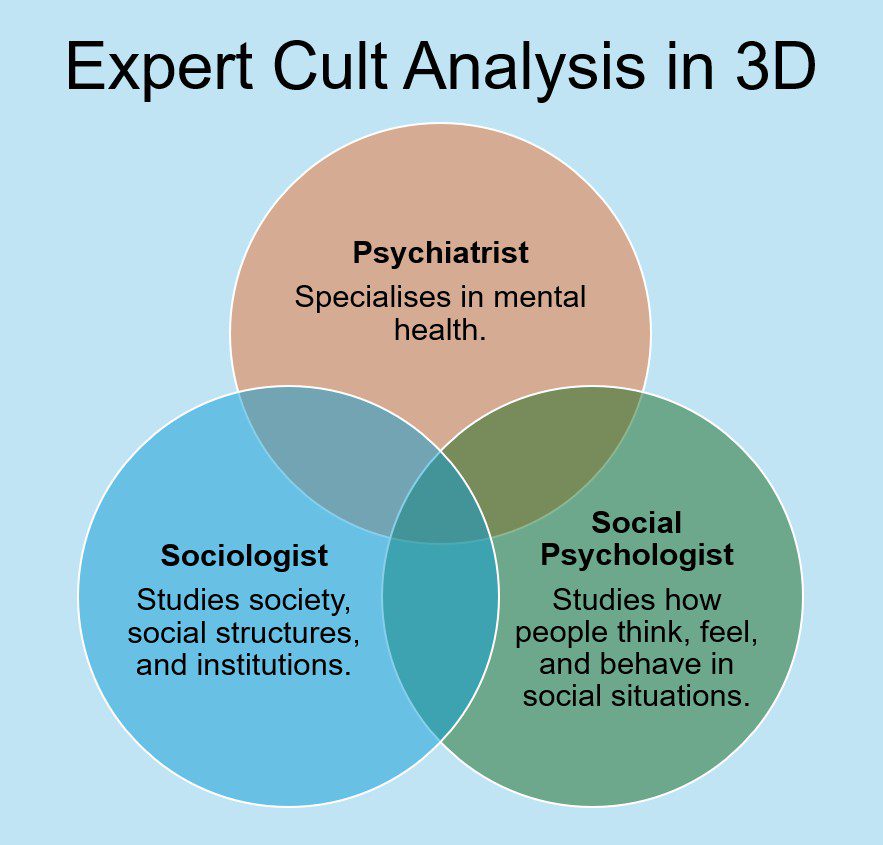
For a full 3D perspective on cults, see below insights from 4 of the most renowned worldwide experts on cults, each with their own specialism: a top psychiatrist, a clinical psychologist, a sociologist, and a social psychologist. Then we round up with a cult signs checklist that you can use to examine any church or organisation’s ideology, environmental controls, social structures, and persuasion tactics, to evaluate how cultish they are.
Insights from 4 world-class cult specialists:
1) Robert J. Lifton
Bio: Dr Robert Jay Lifton is an American psychiatrist and distinguished professor who specialised in the psychology of totalism. He is world-renowned for his groundbreaking 1961 study on cognitive remoulding and psychological vulnerability, which provided the foundational criteria for analysing thought reform.

Core Theories and Insights:
Milieu Control: The strict limitation of all communication and information reaching an individual from the outside world, creating a closed information ecosystem.
Mystical Manipulation: Orchestrating events or experiences that appear supernatural or divinely ordained to make the group’s leadership seem selected by a higher power.
Demand for Purity: Dividing the universe into an absolute black-and-white binary of pure good (the group) and absolute evil (the outside world).
Cult of Confession: Requiring members to confess sins, doubts, and past mistakes to leadership, which is later weaponised to destroy individual boundaries.
Sacred Science: Elevating the group’s primary dogma to an absolute truth that cannot be questioned by logic, science, or human reason.
Loading the Language: Compressing complex human thought into thought-terminating clichés and jargon that restrict critical thinking.
Doctrine Over Person: Prioritising the group’s abstract teachings over actual human experiences, rewriting individual histories to fit the narrative.
Dispensing of Existence: Proclaiming that only those inside the group have a right to exist, be happy, or achieve spiritual salvation.
2) Margaret T. Singer
Bio: Dr Margaret Singer was a clinical psychologist and professor at UC Berkeley who specialised in the treatment of former cult members. She spent decades researching the mechanics of coercive persuasion and the systematic steps groups use to destabilise an individual’s identity. She wrote the well-known book ‘Cults In Our Midst’, as pictured here.
Core Theories and Insights:
Behavioural Destabilisation: Systematically altering an individual’s physical environment, sleep patterns, and daily routines to break down their emotional resilience.
Unconditional Reality Redefinition: Forcing a newcomer to accept a new worldview by punishing critical thinking and rewarding compliance.
Exploitation of Vulnerabilities: Utilising a person’s underlying anxieties, past traumas, or psychological transitions (like moving or a breakup) to gain leverage.
Controlled Dependency: Forcing members to rely completely on the group for emotional support, financial decisions, and validation, isolating them from their biological families.
Enforced Suppression of Critical Thought: Training members to suppress negative thoughts, doubts, or criticisms of the leader through psychological defence mechanisms.
Systematic Isolation: Physically or socially detaching individuals from any external sounding boards or objective third parties who could break the psychological loop.
3) Richard J. Ofshe
Bio: Dr Richard Ofshe is an American sociologist and professor emeritus at UC Berkeley specialising in coercive social control. He is a leading expert on thought reform programmes, organisational transformation, and how social systems produce false confessions or fabricated memories. His most famous cult-related work was exposing the Synanon cult; he is the co-author of ‘The Light On Synanon’ along with Dave Mitchell and Cathy Mitchell, as pictured here.

Core Theories and Insights:
Programmatic Thought Reform: Emphasising that cult control is not a sudden “brainwashing” but a step-by-step, organised social system managed within a structured environment.
Identity Manipulation: Forcing members to publicly denounce their previous lifestyle, values, and identities as unworthy or corrupted.
Manufactured Emotional Vulnerability: Using peer pressure and structured social interactions to trigger severe, genuine guilt regarding past behaviours.
Coercive Dependency: Constructing a reward system where an individual can only find relief from manufactured guilt by complying with organisational demands.
Totalitarian Organisational Evolution: Analysing how groups like Synanon transition from benign self-help communities into abusive, self-serving corporations focused entirely on protecting leadership power.
4) Robert B. Cialdini
Bio: Dr Robert Cialdini is a professor emeritus of psychology and marketing at Arizona State University. He is the world’s leading authority on the principles of persuasion, compliance, and how social shortcuts can be weaponised to manipulate human behaviour. He is the author of the best-selling book “Influence: The Psychology of Persuasion”.

Core Theories and Insights:
Reciprocity: Forcing a feeling of debt by offering unexpected gifts, favours, or intense initial affection (commonly known as “love bombing”).
Commitment and Consistency: Leveraging a person’s desire to act aligned with prior statements by securing tiny initial agreements that escalate into extreme sacrifices.
Social Proof: Exploiting the human instinct to look to peers for correct behaviour, surrounding targets with a wall of uniform, ecstatic validation.
Liking: Relying on highly charming, relatable, or physically attractive recruiters who mimic the target’s interests to bypass natural scepticism.
Authority: Demanding automatic compliance through the display of absolute titles, perceived wisdom, or symbols of power.
Scarcity: Manufacturing an artificial sense of urgency by claiming that salvation, truth, or membership is highly exclusive and limited.
Unity: Exploiting the deep, evolutionary need for belonging by establishing a shared tribal identity that frames all outsiders as a hostile “out-group”.
Why understanding cult warning signs is important
When looking for characteristics of a cult, it is crucial to recognise that high-control groups rarely present themselves as malevolent. Instead, they exploit universal human needs: the desire for community, meaning, and security. This is important to understand because recruitment of new members is normally deceptive; cults do not fully disclose their aims, practices, and beliefs to new potential members.
By looking through the combined lenses of sociology, psychology, and persuasion science, the core traits of a high-control system become clear:
- Infallible Leadership: Power is centralised in a leader or ruling council whose actions are completely beyond scrutiny, question, or accountability.
- Ecosystem Isolation: The group systematically severs a member’s ties to the outside world, labelling family, friends, and independent media as spiritually dangerous or toxic.
- Black-and-White Thinking: The group enforces an uncompromising binary worldview. You are either inside and saved, or outside and condemned.
- Weaponised Psychology: Personal disclosures, confessions, and emotional vulnerabilities shared in confidence are catalogued and used as tools of shame to enforce compliance.

Cult Checklist
Use this evaluation to test any religious community or organisation:
Phase 1: Environment and Information (The Lifton Test)
- Does the leadership discourage you from reading outside news, critical websites, or books written by former members?
- Does the group use specialised jargon, acronyms, or repetitive phrases to cut off difficult conversations or doubts?
- Are natural disasters, personal coincidences, or ordinary successes constantly framed as supernatural signs of the group’s favour?
- Are you told that leaving the group will result in a loss of spiritual salvation, personal ruin, or divine punishment?
Phase 2: Psychological Destabilisation (The Singer Test)
- Does the group’s schedule intentionally cause physical exhaustion or keep you too busy to maintain outside relationships?
- Are you expected to completely terminate your critical thinking on entry, and rely entirely on leadership for personal decisions?
- Did the group aggressively target you or change its behaviour toward you during a period of intense personal crisis or vulnerability?
- Are you systematically discouraged or prohibited from speaking with friends, family, or counsellors who criticise the organisation?
Phase 3: Social and Identity Control (The Ofshe Test)
- Are you pressured to publicly denounce your past life, hobbies, career goals, or unaligned family members as bad or sinful?
- Does the group construct environments where your peers continuously analyse, critique, or humiliate you for tiny infractions?
- Do you feel a constant, manufactured loop of guilt that can only be relieved by committing more time, money, or energy to the group?
- Has the organisation historically escalated its demands, becoming increasingly restrictive, insular, and hostile over time?
Phase 4: Everyday Compliance Tactics (The Cialdini Test)
- Did your arrival trigger overwhelming praise and affection (“love bombing”) that now makes you feel deeply indebted to the group?
- Were you led into making small commitments that gradually escalated into huge sacrifices of your time, autonomy, or finances?
- Are you surrounded by a hyper-synchronised community where dissent is invisible, making you feel crazy for having a single doubt?
- Does the group claim that they are the only source of absolute truth on Earth and that your window of opportunity to join them is closing fast?
Scoring the Test:
0–3 Checkboxes: Normal high-commitment organisation. Healthy groups allow for transparency, independent thought, and outside relationships.
4–8 Checkboxes: Moderate concern. The organisation is utilising heavy compliance tactics and psychological pressure. Proceed with caution.
9+ Checkboxes: High cultic risk. The organisation displays a pattern of coercive control, identity manipulation, and structural isolation across all four expert dimensions.